
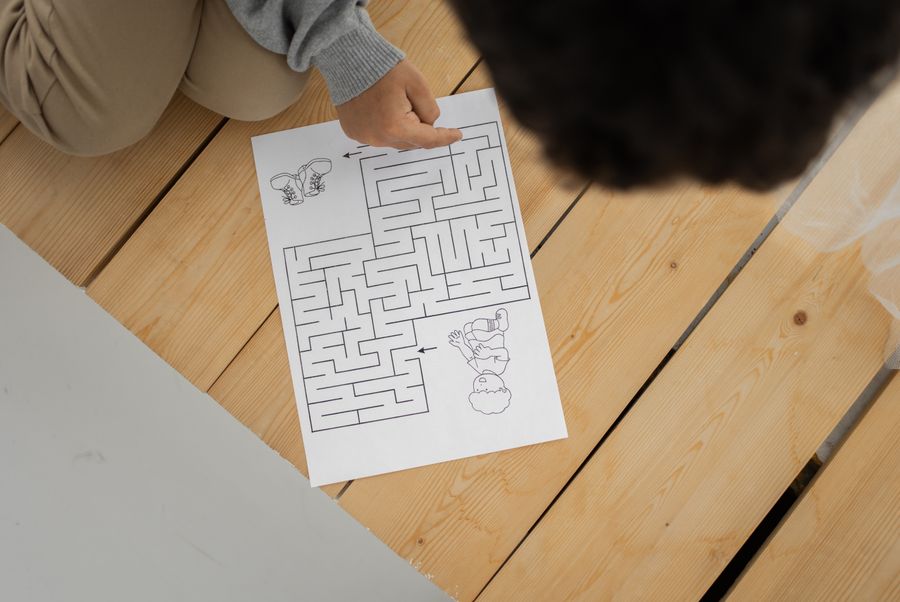
Mazes are pure magic for kids. A simple line drawing turns into an adventure—start here, twist there, avoid the dead ends, and celebrate at the finish. Beyond the giggles and “I did it!” moments, drawing and solving mazes builds fine motor skills, spatial awareness, problem-solving, patience, and focus. At PrintableMaze.org we offer thousands of free printable mazes for every age, yet nothing beats the pride kids feel when they create their own.
This guide shows you exactly how to draw a maze for kids—simple enough for preschoolers, flexible enough for older elementary children, and ready for classroom or home use. You’ll learn age-appropriate techniques, design tips that keep frustration low and fun high, and creative ways to turn homemade mazes into lasting activities. Along the way we’ll touch on why mazes support brain development and how solving strategies (and even Python coding) can deepen the learning.
Why Draw Mazes with Kids?
Drawing a maze is active creation rather than passive consumption. Children plan a path, add challenges, test solvability, and then watch someone else solve their invention. That process strengthens executive function: planning, inhibitory control, cognitive flexibility, and working memory. Research and classroom experience show mazes improve visual-motor integration, sustained attention, and spatial reasoning—skills that transfer to writing, math, reading maps, and everyday navigation.
They also offer a perfect screen-free, low-prep activity. All you need is paper, a pencil, and an eraser. Themes (animals, vehicles, holidays, favorite characters) make the activity personal. And because kids design the difficulty themselves, the maze stays just challenging enough.
Materials You’ll Need
- Plain paper or graph paper (graph paper helps beginners keep pathways even)
- Pencil and eraser
- Optional: ruler, colored pencils or markers, stickers, or stamps for decoration
- For very young kids: thicker paper and crayons so lines stay bold
Step-by-Step: How to Draw a Simple Kids Maze
1. Draw the outer border
Start with a large rectangle or square that fills most of the page. Leave a small margin. For younger children, make the border thick and bold so the maze feels contained and safe. You can also use fun shapes—hearts, circles, animal outlines, or house shapes—once kids are comfortable with rectangles.
2. Mark Start and Finish
Choose two openings on opposite sides (or adjacent sides for shorter paths). Label them clearly with the words “START” and “FINISH” or simple arrows and icons. Wide openings prevent early frustration.
3. Sketch the main solution path first
This is the secret to a fair maze. Lightly draw one continuous, winding path from Start to Finish. Keep the corridors wide—about the width of a finger or a thick crayon line for preschoolers. Avoid sharp corners that are hard to navigate with chubby hands. The path should feel like a gentle journey rather than a tight rope.
4. Add short, obvious dead ends
Branch a few short side paths off the main route. Make them clearly dead-end so kids can see the mistake quickly and try again. Too many long, sneaky dead ends create frustration; a few obvious ones teach the concept of “wrong turn” without discouraging the solver.
5. Fill in the remaining walls
Connect the dead ends and remaining open space with walls so every corridor is closed except the true path. Keep pathways consistently wide. Erase any overlapping lines or accidental openings. The finished maze should have exactly one continuous solution.
6. Test and decorate
Trace the solution yourself with a different color. If it works, erase the test line (or leave a light version for answer keys). Add simple decorations outside the walls or in dead ends—stars, animals, treasure chests—without cluttering the paths. Kids love personalizing their creations.
Age-Appropriate Variations
Toddlers & Preschoolers (ages 2–5)
Extremely wide paths, only one or two short dead ends, large Start/Finish icons, and bold lines. Themes such as “help the bunny find the carrot” or “drive the car to the garage” keep motivation high. Let them color the finished maze afterward.
Early Elementary (ages 5–8)
Slightly narrower paths, more turns, and 4–6 dead ends. Introduce simple grids or free-drawn curves. Encourage themes tied to current interests—dinosaurs, space, sports, or seasonal holidays.
Older Kids (ages 9+)
Tighter paths, longer false routes, multiple decision points, and optional extra challenges (collect three stars along the way, avoid “traps”). They can experiment with circular, triangular, or picture-shaped borders and even design multi-page “adventure” mazes.
Design Tips That Keep Mazes Kid-Friendly
- Prioritize width over complexity. Wide corridors reduce fine-motor strain and visual overwhelm.
- Keep dead ends short and visible. Long, looping traps frustrate young solvers.
- One solution only. Multiple exits or loops confuse the learning goal.
- Clear labeling. Start and Finish should be unmistakable.
- Theme it. A maze about “finding the lost puppy” is far more engaging than abstract lines.
- Leave white space. Crowded mazes feel chaotic; breathing room feels inviting.
- Test before sharing. Always verify solvability yourself.
Creative Extensions and Classroom Ideas
Once kids master the basics, turn maze-drawing into a richer project:
- Create a class maze book—each student contributes one page.
- Design “story mazes” where the path follows a short narrative.
- Make reusable versions by laminating and using dry-erase markers.
- Host a maze-solving race or quiet center activity using the homemade puzzles.
- Pair drawing with solving practice. After creating, kids can trade mazes and apply strategies such as the wall-follower method or dead-end filling.
For teachers and homeschoolers, homemade mazes fit perfectly into early-finisher bins, brain breaks, fine-motor stations, and spatial-reasoning lessons. They complement any curriculum without extra prep cost.
Mazes and the Brain: More Than Just Fun
Mazes are excellent brain exercise. Navigating paths strengthens the hippocampus (spatial memory and navigation) and prefrontal cortex (planning and decision-making). Kids practice working memory by remembering which routes failed, cognitive flexibility when switching strategies, and inhibitory control by resisting impulsive turns. Sustained attention improves because the task demands focus from start to finish. Regular engagement with mazes and similar puzzles supports executive function and can contribute to overall cognitive resilience—exactly why many educators and therapists include them in daily or weekly routines. For a deeper look at these benefits, explore our related discussion on whether mazes are good for the brain.
From Drawing to Solving (and Even Coding)
Drawing teaches design thinking; solving teaches strategy. Classic paper methods include the right-hand (or left-hand) wall-follower rule for simply connected mazes and dead-end filling for whole-maze overview. These techniques turn random trial-and-error into systematic problem-solving. For older students ready for a computational challenge, learning how to solve a maze puzzle efficiently in Python opens the door to algorithms such as depth-first search, breadth-first search, and A*. Representing a maze as a grid or graph and writing code to find the path is a natural next step after hand-drawing. Teachers and parents looking for printable strategy guides can also download resources on how to solve a maze puzzle strategies in PDF form for classroom handouts or independent practice.
Free Printables to Inspire More Creation
After kids finish their hand-drawn mazes, reinforce the skills with ready-made practice. PrintableMaze.org offers free, high-quality PDF maze worksheets in dozens of themes and difficulty levels—perfect for toddlers through teens. Download, print, and use them as warm-ups, rewards, or extensions. No sign-up required, and every maze is designed to be kid-safe and classroom-ready.
Final Encouragement
Drawing a maze for kids is simple, joyful, and surprisingly educational. Start with a border, a clear path, a few friendly dead ends, and plenty of encouragement. In minutes you’ll have a personalized puzzle that builds skills, sparks creativity, and creates shared laughter. Whether you’re a parent looking for a rainy-day activity, a teacher filling a learning center, or a child discovering the power of their own ideas, maze-making turns ordinary paper into an adventure.
Grab a pencil, open a fresh page, and begin. The next great maze is waiting to be drawn—by you and the kids you love. Then visit PrintableMaze.org for thousands more free printable mazes to keep the fun (and the brain-building) going every day.

Comments
0 responsesNo comments yet. Be the first to share your thoughts.