
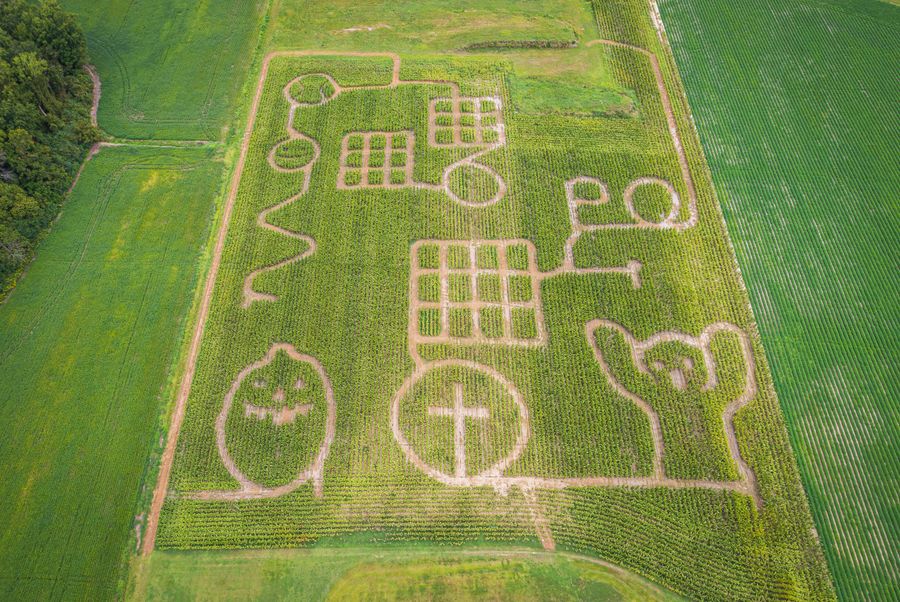
Every autumn, millions of families venture out to farms across America, ready to get lost in towering walls of corn. It’s a beloved fall tradition—but have you ever stopped to wonder: how are corn mazes actually made?
The answer is far more complex—and fascinating—than you might expect. Behind every intricate design lies a remarkable blend of agricultural expertise, artistic vision, and modern technology. Let’s take a deep dive into the world of corn maze creation, from the first spark of an idea to the opening day when visitors step into the towering stalks.
A Brief History: Where Did Corn Mazes Come From?
Before we explore how corn mazes are made, it helps to understand where this uniquely American tradition began. The concept of mazes is nothing new—they date back thousands of years. The ancient Egyptians and Greeks built labyrinths for spiritual purposes, and the famous labyrinth of Crete, which housed the mythical Minotaur, is one of the earliest known examples. Hedge mazes became popular among European aristocracy in the late 17th century, with the Hampton Court Maze in London—dating back to the 1690s—being the oldest surviving example.
But the idea of turning a cornfield into a maze didn’t emerge until much later. The first modern corn maze was created in 1993 by Don Frantz and Adrian Fisher at Lebanon Valley College in Annville, Pennsylvania. Frantz, a creative director who had worked on Broadway shows and the Super Bowl Halftime Show, got the idea while looking down at farmland from an airplane. The result was a three-acre field dubbed “The Amazing Maize Maze,” cut into the shape of a dinosaur named “Cornelius the Cobasaurus”.
Today, there are more than 500 corn mazes across the United States, with some spanning over 100 acres. But the process of creating them has evolved dramatically since that first dinosaur-shaped maze.
The Five-Step Process of Making a Corn Maze
Creating a corn maze isn’t something you can throw together in a weekend. It’s a year-round endeavor that requires careful planning, precise execution, and a lot of patience.
Step 1: Planning and Design (Winter to Early Spring)
The process begins months before the first seed goes into the ground. Farmers typically start designing their maze in the winter, with designs needing to be finalized by early June.
The design phase often starts with a theme. Some farmers choose designs that reflect current events—in 2020, for example, one Colorado farm created a maze thanking healthcare workers and essential workers who sacrificed during the pandemic. Others draw inspiration from pop culture, local landmarks, or even Greek mythology.
Once the theme is chosen, the design is mapped out—often on graph paper. A single maze can take 24 pages or more of grid paper to map out. Each square on the paper corresponds to a specific area in the field. Some farmers spend upwards of 40 hours working through the design in software like Adobe Illustrator before committing it to paper.
Modern farmers also use specialized computer software and GPS technology to create detailed layouts. Using tools like Google Earth and agricultural mapping software, they can overlay a design onto a digital map of their field with incredible precision.
Step 2: Planting the Corn (Late May to June)
With the design finalized, it’s time to plant. But corn maze planting is nothing like traditional corn farming.
In a standard cornfield, corn is planted in straight, parallel rows. For a maze, farmers use a two-direction planting method—planting rows both north-south and east-west. This creates a dense, checkerboard-like grid of corn stalks that form thick, impenetrable walls.
Farmers typically plant a high population of seeds—around 38,000 to 44,000 per acre—to ensure dense growth. They also select specific corn varieties, usually forage or silage corn, which grow tall (often reaching 10 to 12 feet), dense, and durable enough to withstand heavy foot traffic and fall weather.
The timing of planting is critical. Most farmers plant their maze corn in late May, with the goal of having the corn a few inches tall by early July when the cutting begins.
Step 3: Cutting the Maze (Early July)
This is where the magic happens—and where the hard work truly begins.
When the corn is still young—just a few inches to about a foot tall—the cutting crew moves in. The timing is crucial: if you wait until the corn is too tall, it becomes nearly impossible to cut clean pathways.
There are two main approaches to cutting a corn maze:
The Traditional Way (Hand Cutting): Many farms still cut their mazes by hand using string trimmers or weed eaters. Workers use the grid system—matching the graph paper design to the actual field—and carefully remove the corn stalks where the pathways will go. Flags and spray paint mark the cutting path. It’s painstaking work that can take several days. As one farmer put it, “Probably some of it’s nostalgia. We’ve been doing it this way for a long time. There are machines that would do it, I just think that it’s kind of a passion project”.
The High-Tech Way (GPS-Guided Cutting): A newer, increasingly popular method uses GPS-guided tractors and mowers to cut the design. Farmers upload the digital design to their tractor’s GPS system, and the machine follows the precise coordinates, cutting the pathways with incredible accuracy. Some farms also use “skip planting,” where the planter on the tractor is adjusted to skip rows according to the design, creating paths right from the start.
Step 4: Maintenance (July to September)
Once the maze is cut, the work isn’t over. Throughout the summer, farmers must maintain the pathways by mowing and tilling them regularly to keep them clear. If they only cut once early in the season, the corn will grow back and fill in the paths. Multiple cuttings are essential.
At the same time, farmers must care for the standing corn, ensuring it grows healthy and tall. They may add educational stations, scavenger hunts, or signage throughout the maze to teach visitors about agriculture. By September, the corn has typically reached its full height—often 10 to 12 feet tall—creating those iconic towering walls that make corn mazes so immersive.
Step 5: Opening Day and Beyond
When autumn arrives, the maze opens to the public. Visitors navigate the winding paths, and farms often station staff inside to help guide people who get turned around. At the end of the season—typically around November 1st—the maze is mowed down, and the corn stalks are chopped and left to decay over the winter, returning nutrients to the soil.
Technology Meets Tradition
What’s remarkable about corn maze creation is how it bridges old and new. Some farms still use the original grid-and-graph-paper method, cutting by hand with string trimmers. Others use cutting-edge GPS technology and specialized software.
But regardless of the method, one thing remains constant: the dedication. As one farmer reflected, “I’m just so thankful for the corn maze and the opportunity to get to entertain people like we do”.
Why Mazes Are Good for Your Brain
Beyond the sheer fun of getting lost in a cornfield, mazes offer genuine cognitive benefits. Whether you’re navigating a giant corn maze or solving a paper puzzle, you’re giving your brain a serious workout.
Solving mazes improves problem-solving skills by requiring you to think ahead, plan routes, and adapt when you hit dead ends. Spatial reasoning gets a boost as you visualize the layout and your position within it. Memory improves as you remember which paths you’ve already tried and which landmarks to watch for. Mazes also enhance focus and concentration—essential cognitive skills for learners of all ages.
Regularly engaging with mazes—whether in a cornfield or on paper—can help develop patience, persistence, and critical thinking. They’re not just entertainment; they’re a brain-boosting activity disguised as fun.
From Cornfield to Puzzle Page
The process of designing a corn maze shares surprising similarities with drawing a maze on paper. Both start with a clear vision, a grid system, and careful planning. If you’re interested in creating your own mazes—whether for fun, education, or just to challenge your friends—check out our guide on how to draw a maze for kids. It’s a great way to understand the fundamentals of maze design on a smaller scale.
And if you ever find yourself stuck in a maze—corn or otherwise—remember that there are strategies to help you find your way. Our resources on how to solve a maze puzzle efficiently in Python and how to solve a maze puzzle strategies PDF offer practical techniques for navigating even the trickiest labyrinths.
Final Thoughts
The next time you step into a corn maze this fall, take a moment to appreciate the incredible effort behind it. From the winter brainstorming sessions to the summer days spent cutting pathways by hand or by GPS, every corn maze is a testament to human creativity, agricultural know-how, and good old-fashioned hard work.
And as you navigate those towering walls of corn, remember: you’re not just having fun—you’re giving your brain a workout too. If you’re curious about the cognitive benefits, explore more in our article on are mazes good for the brain.
So go ahead—get lost. It’s all part of the experience. And if you need a little help finding your way out, well, that’s what the map is for.

Comments
0 responsesNo comments yet. Be the first to share your thoughts.