
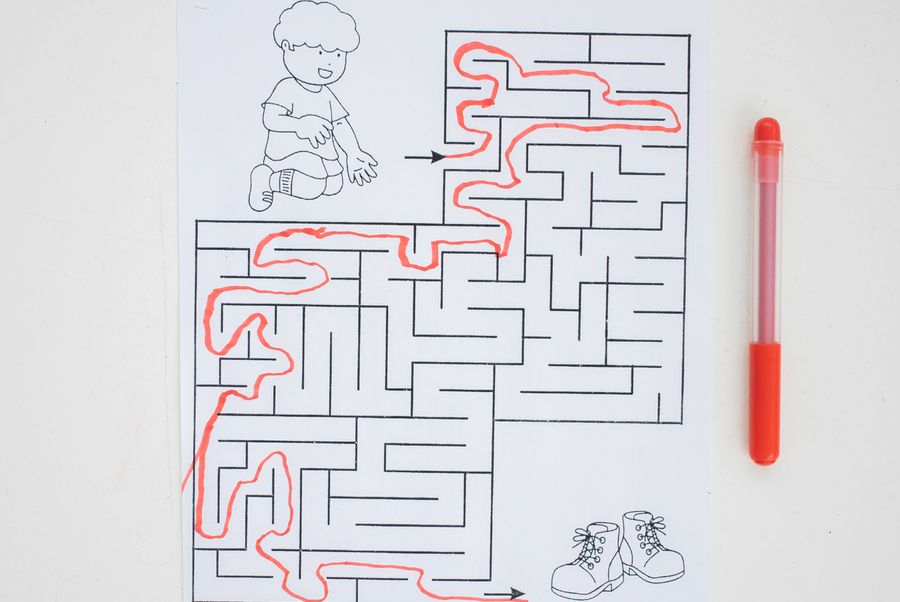
There’s something universally compelling about a maze. From the hedge mazes of European castles to the pencil-and-paper puzzles in activity books, the challenge of finding a path from start to finish has captivated humans for centuries. It’s a pure test of spatial reasoning, patience, and strategic thinking.
But here’s the secret: solving a maze isn’t just about luck or intuition. There are systematic strategies—some simple enough for a child to learn, others powering the autonomous vehicles of tomorrow—that can guarantee you’ll find your way through. Whether you’re a puzzle enthusiast looking to sharpen your skills, a parent helping a child with a maze book, or a student curious about the algorithms behind pathfinding, this guide covers everything you need to know.
Part 1: The Foundation—Essential Pencil-and-Paper Strategies
Before diving into computer algorithms, let’s start with the practical techniques you can use right now on any printed maze. These strategies come from puzzle experts and educators who have spent years studying how people solve mazes effectively.
1. Always Use a Pencil with a Good Eraser
This might sound obvious, but it’s the single most important piece of advice. Mistakes are common when solving puzzles, and erasers exist for a reason. Don’t be afraid to make mistakes—they’re part of the learning process. A pencil allows you to experiment, backtrack, and refine your path without leaving permanent clutter on the page.
2. Fill in the Corners
Here’s a clever technique that many solvers overlook. In many maze puzzles—particularly “turn mazes” where the path must pass through every square—the path through a corner square must enter and exit through the squares that touch it. If you identify that the path enters a square that touches a corner square, it must continue through the corner next. This forces certain route decisions and can eliminate dead ends before you even start exploring.
3. Don’t Block Squares
In puzzles where the path must traverse every square, it’s crucial not to create squares that the path can’t pass through. Before committing to a direction, think ahead: “If I go this way, will any square become unreachable?” This foresight prevents you from painting yourself into a corner—literally.
4. Draw Known Parts of the Path First
Sometimes, certain sections of a maze have only one possible solution. Identify these “forced moves” and draw them in immediately. These anchor points give you reference positions and reduce the complexity of the remaining puzzle. For example, if a path can only make a left turn by entering from the right and turning down, that’s a forced move—draw it and extend from both ends.
5. Work Systematically
As one young puzzle-solver aptly put it: “To solve the maze problem we used a systematic approach. We started off by drawing all of the possible routes from the start to the end of the maze and colour coded them to make them clear”. This methodical approach—mapping all possible routes and evaluating them—ensures you don’t miss the correct path.
6. Take Breaks and Come Back
When you’re stuck, sometimes the best strategy is to walk away. Skip the puzzle and return later with fresh eyes. What seemed impossible before might suddenly become obvious after a mental reset.
Part 2: The Physical Strategies—Navigating Real Mazes
If you’re facing a physical maze—whether it’s a corn maze, a hedge maze, or even a life-sized labyrinth—these strategies will guide you through.
The Wall Follower (Right-Hand or Left-Hand Rule)
This is the most famous maze-solving technique. Simply place your right hand on the right wall (or your left hand on the left wall) and keep it in contact as you walk. Whenever you come to a decision point, turn in the direction that keeps your hand on the wall.
Why it works: In a “simply connected” maze—one where all walls are connected to the outer boundary—this rule guarantees you’ll find the exit. By keeping contact with one continuous wall, you’ll eventually traverse the entire boundary and reach the exit.
The catch: This method fails in mazes with “islands”—disconnected wall sections—or if the start and exit are not on the outer walls. If the solver starts inside the maze on a section disconnected from the exit, wall followers will endlessly circle their ring without reaching the goal.
The String Method (Ariadne’s Thread)
Take a tip from Greek mythology. Trail a length of string behind you as you explore. When you hit a dead end, follow the string back to the last junction and try another path. This ensures you never get lost and can systematically explore every branch.
The Random Walk
Sometimes the simplest approach works: just keep moving. By the laws of probability, a random walk through a finite maze is guaranteed to eventually deliver you to the goal. It might not be efficient, but if you have unlimited time, it will work.
Part 3: The Computer Science—Algorithms That Power Maze Solving
Beyond pencil-and-paper puzzles, maze solving is a foundational problem in computer science, robotics, and artificial intelligence. Understanding these algorithms reveals why some strategies work and others don’t—and shows how the same principles that solve puzzles also guide self-driving cars and delivery drones.
Depth-First Search (DFS) / Recursive Backtracking
This is the computer science equivalent of the string method. The algorithm explores as far as possible along each branch before backtracking.
How it works: Starting from the entrance, the algorithm tries moving in one direction. If it hits a wall or a previously visited area, it returns failure and tries another direction. If it reaches the finish, it returns success. The path is marked as it goes, and erased when backtracking, leaving only the solution when success is achieved.
Pros and cons: DFS will always find a solution if one exists, but it won’t necessarily find the shortest one. It can get stuck going down a wrong path for a very long time before finding the correct route. However, it has modest memory requirements—it only needs to store a single path from root to leaf, along with sibling nodes.
Time complexity: O(b^m), where b is the branching factor and m is the maximum depth. In plain English: the deeper and more branching the maze, the longer it takes.
Breadth-First Search (BFS)
Instead of diving deep down one path, BFS explores all paths simultaneously, level by level. It checks all paths that are one step from the start, then all paths two steps away, and so on.
The advantage: BFS guarantees finding the shortest path. If there’s a solution, BFS will find it with the minimum number of steps.
The trade-off: BFS requires more memory than DFS because it must keep track of all frontier nodes at each level.
A* Search Algorithm
A* is the gold standard for pathfinding in games and robotics. It combines the best of both worlds: it uses a heuristic (a smart guess) to prioritize paths that seem most promising toward the goal.
How it works: A* evaluates each path based on two factors: the cost to reach the current point, plus an estimate of the remaining cost to reach the goal. This “informed” approach makes it significantly faster than blind search methods for most real-world applications.
Real-world applications: A* and similar algorithms power navigation systems in self-driving cars, route planning for delivery drones, character movement in video games, and even GPS navigation.
Trémaux’s Algorithm
Named after the French mathematician, this algorithm is designed for situations where the wall follower fails—specifically, mazes with loops or disconnected sections.
How it works: The solver marks each path it traverses. When it reaches a dead end or a previously visited junction, it backtracks, marking the path in a way that indicates it’s been fully explored. This systematic marking guarantees that every passage is eventually explored.
Why it’s superior: Unlike the wall follower, Trémaux’s algorithm works in all mazes—even those with complex loops and multiple islands. It’s considered one of the best “doable inside” algorithms for maze exploration.
The Pledge Algorithm
Think of this as an upgraded wall follower. The Pledge algorithm can solve mazes even when the solver starts inside the maze, not just on the outer boundary.
How it works: The algorithm uses a compass direction as a reference. The solver follows walls but keeps track of its cumulative turning angle. When the cumulative turn returns to zero (meaning it’s facing the original direction), it temporarily leaves the wall and moves forward.
Comparative Performance
Research shows that no single algorithm performs optimally across all maze types. The choice of algorithm depends on the maze’s characteristics:
| Algorithm | Best For | Weakness |
|---|---|---|
| Wall Follower | Simple connected mazes | Fails with islands/loops |
| DFS/Backtracking | Finding any solution | Won’t find shortest path |
| BFS | Finding shortest path | High memory usage |
| A* | Efficient pathfinding | Requires good heuristic |
| Trémaux’s | Complex mazes with loops | Requires marking |
| Pledge | Starting from inside | More complex to implement |
A simulation-based study comparing Random Mouse, Wall Follower, Pledge, Trémaux, and Dead-End Filling found that each algorithm performed differently depending on whether the maze had dead ends only, loops only, or both.
Part 4: Mazes in Education and Cognitive Development
Maze puzzles aren’t just fun—they’re genuinely good for you. Educators and researchers have long recognized the value of maze solving for developing critical thinking skills.
Teaching Computational Thinking
Maze generation and solving algorithms are increasingly used in educational settings to teach basic programming concepts and computational thinking to children. The Hunt-and-Kill and Recursive Backtracker algorithms, for example, maintain high ratios of longest paths, making them suitable for generating complex mazes for advanced game levels.
Building Problem-Solving Skills
The strategies for solving mazes—systematic exploration, pattern recognition, working backward from constraints—are transferable skills applicable to mathematics, logic puzzles, and real-world problem-solving.
The Joy of Perseverance
As one young solver reflected: “I will do my best and never give up. I say this to myself so I don’t feel discouraged”. Maze solving teaches resilience. Even when the path isn’t obvious, persistence and systematic thinking will eventually lead to success.
Part 5: Resources—Where to Find Mazes and Strategy Guides
If you’re ready to put these strategies into practice, here are some excellent resources.
PDF Strategy Guides
- Beast Academy Puzzles offers a free PDF guide to “Turn Mazes Strategies” with practical tips including using a pencil, filling in corners, avoiding blocked squares, and taking breaks.
- Puzzle Solving Techniques by Cihan Altay is available as a downloadable PDF covering various puzzle-solving methodologies.
- Mazes for Programmers by Jamis Buck (available as PDF) teaches six maze algorithms and introduces Dijkstra’s algorithm for solving, analyzing, and visualizing mazes.
Printable Mazes with Solutions
Several websites offer free printable maze puzzles in PDF format with solutions included:
- Masked Maze Generator lets you create custom-shaped maze puzzles and download them with solutions in PDF, PNG, or SVG formats.
- Printable Creative offers an online maze generator with unlimited unique puzzles in various shapes and sizes.
- Starlight Tools provides a free maze generator that can print mazes with or without solutions.
- Do You Maze offers free downloadable PDFs of area maze puzzles with answers.
- Just Printables has a variety of free printable mazes for kids with solutions included.
Academic Resources
For those interested in the deeper theory, several academic papers provide comprehensive reviews of maze-solving algorithms:
- A Review of Various Maze Solving Algorithms (2026) provides a comparative review of classical, heuristic-driven, sampling-based, and hybrid approaches.
- A Comprehensive Investigation of Algorithms for Solving Mazes covers wall-following, backtracking, M-DFS, and A* algorithms.
- Comparative Analysis of BFS, Dijkstra, and A* Pathfinding Algorithms offers a detailed time-based comparison of these three popular approaches.
Conclusion: The Path Forward
Whether you’re tracing a path with a pencil, navigating a corn maze with your hand on the wall, or programming a robot to explore unknown terrain, the fundamental principles remain the same: systematic exploration, careful marking of progress, and the willingness to backtrack when you hit a dead end.
The beauty of maze solving is that it scales from the simplest children’s puzzle to the most complex problems in artificial intelligence and robotics. A child learning the right-hand rule is taking their first steps toward understanding computational thinking. A researcher developing hybrid algorithms for maze-solving robots is pushing the boundaries of what machines can achieve.
And perhaps most importantly, maze solving teaches us something about life itself: the path isn’t always straight, dead ends are inevitable, and sometimes you have to backtrack to find the right way forward. But with patience, strategy, and perseverance, there’s always a way through.
So grab a pencil, download a maze PDF, and start practicing. The more you solve, the better you’ll become—and before you know it, even the most complex maze will yield to your strategic thinking.

Comments
0 responsesNo comments yet. Be the first to share your thoughts.